
REVIEW · COMMUNIST HISTORY TOURS
Sofia Food & Tasting Tour with Communist-Era Tram Ride
Sofia tastes better with a local guide. This three-hour tour mixes five food stops with the city’s grand cathedral, Roman ruins, markets, mosques, and mineral springs. I like the way Peter connects each bite to Sofia’s past, and I like the small group limit of 11 people. The main consideration is pace: you cover a lot of ground, and some stops are brief.
The route begins at Alexander Nevsky Cathedral and finishes below the Central Market Hall, giving you a useful walk through central Sofia. Bulgarian beer, local wine, traditional meals, salad, appetizers, and dessert are included, but alcohol is not suitable for anyone 17 or younger.
Peter is the guide, and his personal touch is a major part of the experience. He has adjusted routes for solo participants, helped guests find concert venues, and used the tram when hot weather made walking less pleasant. If you want a polished sightseeing lecture, this may feel informal. If you want food, local stories, and a guide who responds to the group, it is a strong choice.
In This Review
- Five things that make this Sofia tour different
- Starting beneath Alexander Nevsky’s golden domes
- Books, stained glass, and Bulgaria’s civic center
- Local food and the market district
- Roman Serdica beneath modern Sofia
- Synagogue, hot springs, and an Ottoman mosque
- The tram ride and the communist-era finish
- What the $91.07 price really covers
- Timing, food needs, and who should book
- Should you book Peter’s Sofia food tour?
- FAQ
- How long does the Sofia Food and Tasting Tour last?
- Where does the tour start?
- Where does the tour end?
- How many people can join the tour?
- What food and drinks are included?
- Can dietary restrictions be accommodated?
- Is the tram ride included?
- Is alcohol included for children?
- What is the cancellation policy?
Five things that make this Sofia tour different
- Food comes throughout the walk: You do not wait until the end for one large meal. Bulgarian sausages, cheese, salads, snacks, drinks, and dessert appear at five stops.
- The communist-era tram adds local texture: The ride gives your feet a break and brings the city’s recent past into the tour.
- Peter keeps the group personal: With a maximum of 11 people, questions and route changes are easier than on a big bus tour.
- The route links several eras: You move from the medieval Orthodox world to Roman Serdica, Ottoman Sofia, modern Bulgaria, and the communist period.
- It is useful on your first day: The walk lays out central Sofia and points you toward places you can revisit independently.
- Dietary needs can be discussed: Vegetarian, vegan, and gluten-free requests can be accommodated if you provide them when booking.
Starting beneath Alexander Nevsky’s golden domes
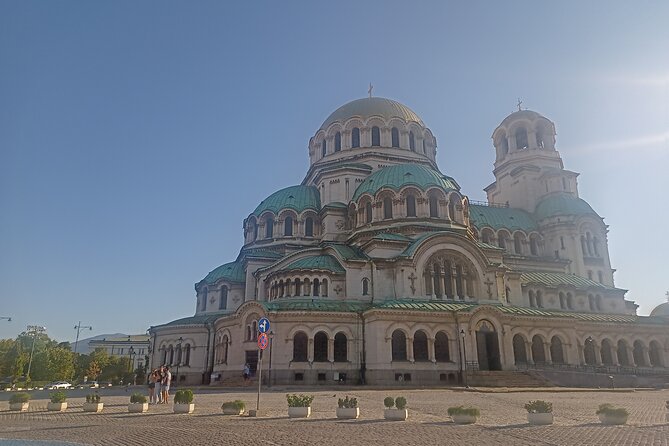
The meeting point is at the Patriarchal Cathedral of St. Alexander Nevsky, on St. Alexander Nevsky Square. This is one of Sofia’s essential sights, so the tour starts in a place you would likely visit anyway.
The cathedral’s Neo-Byzantine design and enormous scale make it an easy opening lesson in Bulgaria’s Orthodox tradition. You have about 10 minutes here, with no admission charge. That is enough for an exterior introduction and a look inside, but not enough for a slow architectural study.
I would arrive early. The cathedral is a clear landmark, yet the square has several important buildings around it. A few spare minutes let you find the guide without turning the beginning into a scavenger hunt.
From here, Peter uses nearby architecture to explain how Sofia was shaped after Bulgaria became an independent state. The tour is not only about ancient ruins. It also deals with the buildings and institutions that helped form modern Bulgaria.
More Food and Drink Tours in Sofia
- Wine Tasting in Heart of Sofia
★ 5.0 · 545 reviews - Wine and Tapas Boutique Bulgarian Wine Tasting
★ 5.0 · 25 reviews - Market Food Tour
★ 4.5 · 21 reviews
Books, stained glass, and Bulgaria’s civic center
The next section takes you toward the National Library, officially the St. St. Cyril and Methodius National Library. It holds about 8.5 million documents, including roughly 17,000 old, rare, and valuable books and periodicals printed from the 15th through the 21st centuries.
You spend around 10 minutes here, with temporary exhibitions available inside. The short visit works best as a cultural stop rather than a full library tour. If a particular exhibition interests you, ask Peter how much time the group can spare.
Nearby, you see the National Assembly building, built between 1884 and 1886 to a design by Constantin Yovanovic. Its historic importance makes it more than a photo stop. It helps explain the civic identity of Sofia after the country’s political renewal in the late 19th century.
Sofia University, founded on October 1, 1888, is also part of this stretch. From Monday through Friday, visitors may be able to see the central hall and its large stained-glass windows. That timing matters. If seeing the interior is important to you, book with a weekday schedule and confirm the access with Peter.
This part of the route gives you a good balance: national culture, public life, and education, all within a walkable central area. Peter’s strength, based on the tour format and guest feedback, is explaining architecture without treating every building like a memorization test.
Local food and the market district
The tour then reaches the area around Zhenski Pazar Market, one of Sofia’s long-established trading centers. The market has operated for more than 140 years and is said to receive almost 60,000 people daily.
This is the sort of place where Sofia feels less arranged for sightseeing. You might see produce, everyday shopping, and local commerce rather than only monuments. The market also sits in the so-called Area of Tolerance, named for the close presence of temples belonging to Bulgaria’s official religious communities.
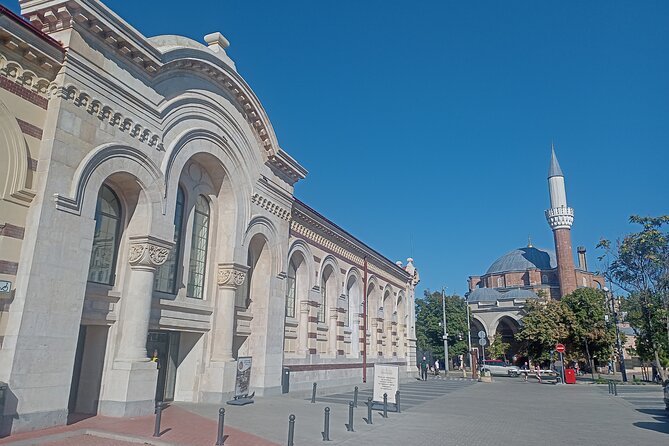
Nearby landmarks include the Church of Saints Cyril and Methodius, Banya Bashi Mosque, and Sofia’s Central Synagogue. The route does not promise full interior visits to each building, so think of this as a guided neighborhood walk with food woven into it.
The first food serving includes traditional Bulgarian sausages, cheese, and a choice of Bulgarian beer or a glass of local wine. The menu also includes traditional meals, salad, snacks, appetizers, and dessert across five food stops.
I like this arrangement because it turns tasting into a gradual meal. You get to try several items instead of ordering one dish and hoping it represents the country well. You should arrive hungry. One guest specifically advised skipping the hotel breakfast, and that is sensible if you want to sample everything.
The exact dishes can vary, but the purpose is clear: Peter takes you to places that are not necessarily obvious to someone walking alone through the center. Several people praised the food as authentic and generous, and one described ending with fried cheese and chicken at a local bar.
Roman Serdica beneath modern Sofia
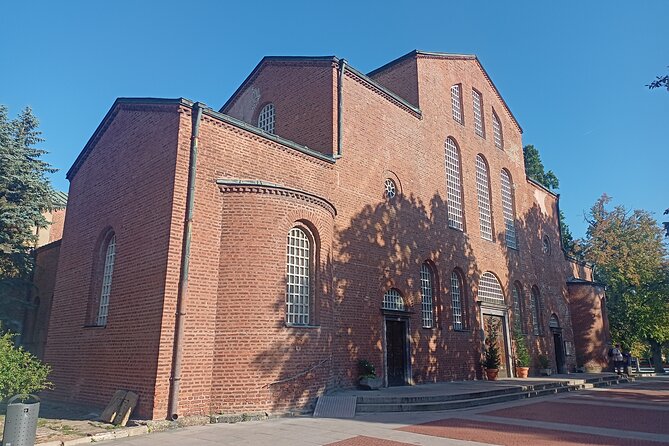
The West Gate of Sofia introduces the Roman chapter. The first fortification wall of Serdica was built in the second half of the second century AD, with a wall about 2.20 meters wide. Later, in the late third or early fourth century, the defenses were rebuilt and a ditch was added.
You have about 10 minutes here, so the guide’s explanation matters more than a long examination of masonry. Peter’s background in architecture and historical events is often praised, including his ability to explain how different periods affected ordinary life.
The Ancient Serdica Archaeological Complex gives you a clearer view of Roman Sofia. Beneath Nezavisimost Square, the Largo zone displays sections of the ancient city alongside a modern public space used for cultural events.
You can see part of the decumanus maximus, one of the main Roman streets connecting the eastern and western gates. South of it is a large residential building that covered an entire city block, or insula. Small shops once served people living in the area and those passing through.
This is a valuable stop because it makes Sofia’s age physical. The ruins are not isolated in a distant archaeological park. They sit under the working center of the capital, with modern streets and squares above them.
Still, the 10-minute timing means you should not expect a museum-level Roman archaeology visit. If ancient Serdica is your main interest, return later on your own and give the complex more time.
More communist-era history in Sofia:
- Communist Walking Tour of Sofia
★ 5.0 · 690 reviews - Sofia Communist History 2-Hour Tour in a Classic Trabant
★ 5.0 · 45 reviews - Buzludzha Monument and the Museum of Socialist Art
★ 5.0 · 25 reviews - Self-guided Tour in the Museum of Socialist Art
★ 4.0 · 4 reviews
Synagogue, hot springs, and an Ottoman mosque
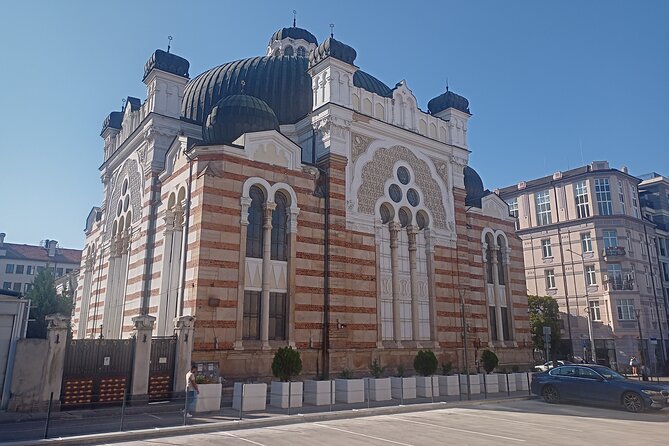
The route continues through Sofia’s religious and Ottoman-era center. The Central Sofia Synagogue is the largest on the Balkan Peninsula and one of Europe’s three largest Sephardic synagogues. Even from outside, its place in the city’s religious mix adds useful context to the nearby mosque and Orthodox churches.
Next come Sofia’s natural hot springs, with water reaching about 46 degrees Celsius. The current Central Mineral Baths building was designed in Vienna Secession style, while also using Bulgarian, Byzantine, and Eastern Orthodox decorative elements.
The building was designed by Petko Momchilov and Friedrich Grünanger in 1904 and 1905, then approved in 1906. This is a fine example of Sofia’s habit of borrowing outside styles and reshaping them for local use.
The Banya Bashi Mosque brings in the Ottoman period. It was designed by Mimar Sinan, the major Ottoman architect also associated with the Selimiye Mosque in Edirne and the Süleymaniye Mosque in Istanbul. The number 974 above the entrance is linked to its construction in 974 of the Hijri calendar, or 1566 to 1567 AD.
Taken together, these stops show why Sofia can feel like several cities stacked in one place. Orthodox, Jewish, Muslim, Roman, Ottoman, and modern Bulgarian landmarks are all close enough to connect in a few hours.
The tram ride and the communist-era finish
The title promises a communist-era tram ride, and the transport element is one of the tour’s most useful touches. The supplied details do not give a fixed tram route or exact ride length, so you should treat it as part of the moving experience rather than a separate museum visit.
The tram also solves a practical problem. One participant joined the ride during very hot weather, and Peter used the tram to get the group out of the heat. That flexibility matters in Sofia, where a sunny walking tour can become tiring quickly.
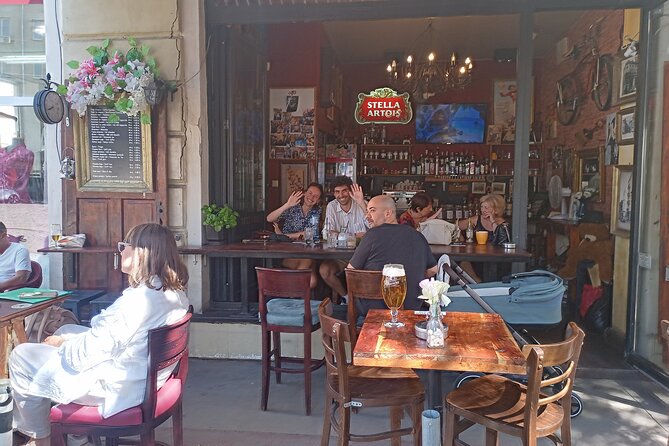
The communist-era setting adds a different layer to the tour. Peter has been praised for explaining the communist period and relating history to family experience. The final stop at a bar or restaurant with a 1960s communist feel gives that subject a physical setting, not just a date on a timeline.
Expect a drink and food there, with beer or wine, local cheese, and other generous appetizers. Fried cheese was singled out as a favorite. The setting sounds deliberately ordinary, which is exactly why it works: you finish in a place linked to everyday social life rather than at another grand monument.
The tour can run longer than the advertised three hours when the group is enjoying itself. That is a pleasant bonus if your schedule is open, but do not book a tight airport transfer or timed attraction immediately afterward.
What the $91.07 price really covers
At $91.07 per person, this is not the cheapest way to walk around Sofia. You are paying for a guide, a small group, five food stops, traditional dishes, salad, snacks, dessert, Bulgarian beer, a glass of local wine, transport during the route, and a city card for the day.
The value improves if you would otherwise pay separately for a meal, drinks, and a guided central-Sofia walk. The experience also saves planning time. You do not need to choose a restaurant, identify Bulgarian dishes, or work out how the Roman ruins relate to the market and religious buildings.
The price is less convincing if you mainly want a large meal or a detailed interior tour of every landmark. Much of the sightseeing is outside, several stops last only 10 minutes, and the included food is spread through the route.
Group discounts may help reduce the cost for larger parties. With a maximum of 11 people, the tour is small enough to feel personal without guaranteeing a private experience.
Timing, food needs, and who should book
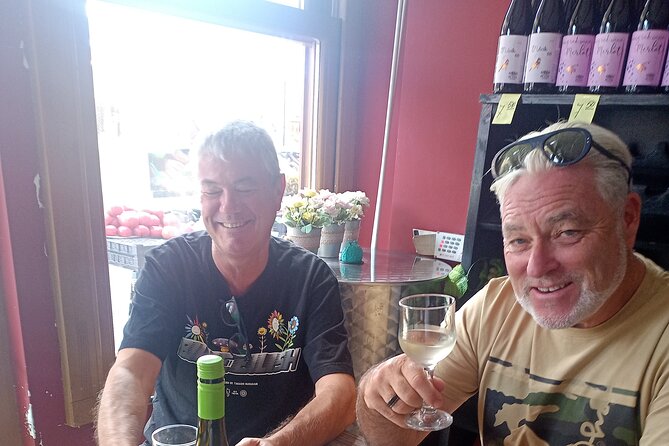
Most people can take part, and the route is near public transportation. Service animals are allowed. Dietary restrictions, including vegetarian, vegan, and gluten-free needs, can be accommodated when you provide them in the special requirements field.
You should also list allergies clearly. The tour provider identifies the 14 major allergens, including gluten cereals, milk, eggs, fish, mustard, peanuts, sesame, soy, tree nuts, celery, crustaceans, molluscs, lupin, and sulphites.
Alcoholic drinks are not suitable for children 17 or younger. The tour is offered in English, and mobile tickets are available.
I would choose this tour early in a Sofia stay. The route gives you a mental map of the center, and Peter has helped people find concert venues and make use of the city after the tour. You may also leave with a short list of bars and restaurants that you would not have found by simply following the main monuments.
It suits first-time visitors, curious eaters, solo visitors, couples, and small groups who enjoy conversation. It is also a good fit if you want recent Bulgarian history included with ancient sites.
I would be more cautious if you dislike walking, need a fixed three-hour finish, want precise portion details in advance, or avoid alcohol and are not interested in the other food included. Tell Peter your needs before starting so he can plan around them.
Free cancellation is available up to 24 hours before the start time. Cancellations or changes made less than 24 hours ahead are not accepted for a refund.
Should you book Peter’s Sofia food tour?
Book it if you want a first taste of Sofia as a living city, not just a parade of monuments. The strongest features are Peter’s warm, flexible guiding, the steady flow of Bulgarian food and drink, and the way the route links Roman ruins, religious buildings, markets, and the communist period.
I would book it near the beginning of a Sofia visit, arrive hungry, and keep the rest of the day flexible. Skip breakfast if you can manage it, mention dietary needs at booking, and wear shoes suited to a substantial city walk.
FAQ
How long does the Sofia Food and Tasting Tour last?
The tour lasts approximately three hours, though it may run longer if the group spends extra time enjoying food, drinks, and conversation.
Where does the tour start?
It starts at the Patriarchal Cathedral of St. Alexander Nevsky in Sofia Center, on St. Alexander Nevsky Square.
Where does the tour end?
It ends on level minus one of the Central Sofia Market Hall, at 25 Knyaginya Maria Luiza Boulevard.
How many people can join the tour?
The maximum group size is 11 people.
What food and drinks are included?
The tour includes five food stops, traditional meals, salad, appetizers, snacks, dessert, Bulgarian beer, and a glass of local wine. A sample starter includes traditional Bulgarian sausages and cheese.
Can dietary restrictions be accommodated?
Yes. Vegetarian, vegan, gluten-free, and other dietary needs can be accommodated if you provide the details when booking.
Is the tram ride included?
Yes, the experience includes travel between stops and features a communist-era tram ride. The exact tram route and ride length are not specified.
Is alcohol included for children?
No. Alcoholic drinks are not suitable for children aged 17 or younger.
What is the cancellation policy?
You can cancel up to 24 hours before the start time for a full refund. Cancellations and changes made less than 24 hours before the start time are not accepted.
Just added in Sofia
- Private Winter Day Trip to the Rila Mountain★ 4.5 · 3 reviews
- Wind Mills Hydropark Tours & Activities★ 5.0 · 1 review
- Weekend in Bulgaria★ 5.0 · 1 review
- Sofia Hidden Gems: Small-Group Walking Tour with Tram Ride★ 5.0 · 7 reviews
- Vratsa Karst and Caves★ 5.0 · 1 review
- Via Ferrata Adventure on Kuklata peak 2257 m in Rila Mountain★ 5.0 · 8 reviews
- Vitosha Trail Hunter Bike Tour from Sofia★ 5.0 · 9 reviews
- Vitosha Mountain- Heritage and Hiking- Private Day Trip★ 5.0 · 2 reviews
Communist History Tours, compared.
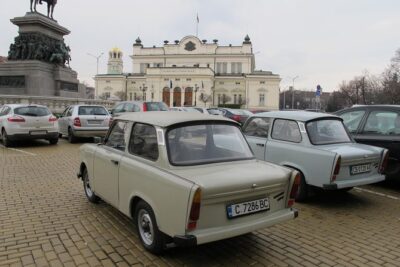
Sofia Communist History 2-Hour Tour in a Classic Trabant
Read our review →Buzludzha Monument and the Museum of Socialist Art
Read our review →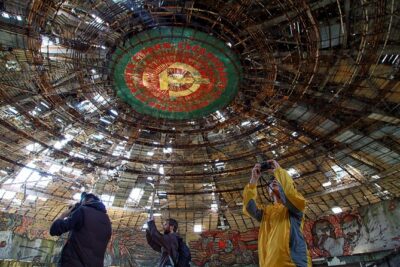
A Day trip to the Thracian Kings, The Valley of Roses & Buzludzha
Read our review →Communist Heritage Tour- Buzludzha and The Might of the East Block Aviation
Read our review →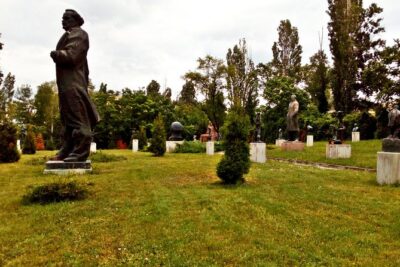
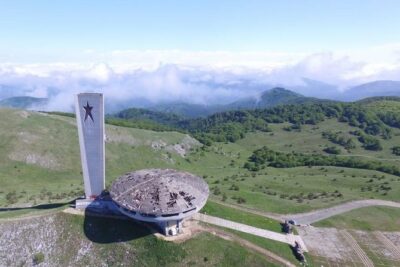
Symbol of the Communism Buzludzha monument and the Rose valley
Read our review →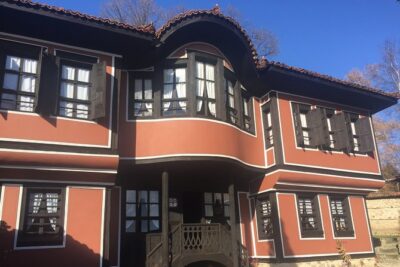
Tour to Koprivshtitsa and the Buzludzha monument incl the Seuthes Thracian Tomb
Read our review →Browse the lists this tour appears in