
REVIEW · WALKING TOURS IN SOFIA
Sofia Hidden Gems: Small-Group Walking Tour with Tram Ride
Sofia rewards curious walkers. This small-group tour links Roman ruins, Orthodox churches, a synagogue, a mosque, grand public buildings, and the city’s oldest market in about two to three hours. I like the mix of famous sights and everyday Sofia, especially the short ride on public transport and the chance to enter the National Library and Sofia University. The main drawback is the brisk pace: with so many stops, most visits last only five to fifteen minutes.
Guide Peter adds warmth and flexibility, answering questions, offering extra locations, and even allowing time for souvenir shopping. I also like the practical finish near Sofia’s Central Market Hall and a bus station. Still, you should wear comfortable shoes, bring sunscreen, and expect a walking tour rather than a series of long indoor visits.
In This Review
- Five good reasons to consider this Sofia walk
- Starting beside Saint Sofia Church
- Alexander Nevski Cathedral and the city’s grand cultural quarter
- Inside the National Library and Sofia University
- Opera, theatre, and the socialist Largo
- The Rotunda of St. George and Ancient Serdica
- Mineral baths, synagogue, and Ottoman Sofia
- The Women’s Market and Banya Bashi Mosque
- What the $45.66 price gets you
- Timing, walking, and who should book
- Should you book this Sofia tour?
- FAQ
- How long does the Sofia walking tour last?
- What language is the tour offered in?
- How much does the tour cost?
- What is included in the tour?
- Where does the tour begin?
- Where does the tour end?
- How large is the group?
- Are admission tickets included?
- Can I cancel for a full refund?
Five good reasons to consider this Sofia walk
- Roman Sofia appears under the modern city: The Rotunda of St. George and Ancient Serdica show how much of Sofia’s past remains beneath its central streets.
- The route includes real working institutions: You visit inside the National Library and Sofia University, not just their façades.
- A short tram or metro ride breaks up the walking: Your transport card is included, giving the tour a useful local touch.
- The group is capped at 10 people: That makes it easier to hear Peter and ask questions.
- The final stretch feels more local: The Women’s Market, Central Market Hall area, Banya Bashi Mosque, and mineral baths give the tour a daily-life side.
Starting beside Saint Sofia Church
The tour begins at Saint Sofia Church on Paris Street in Sofia’s old center. This is a fitting starting point because the church gave the modern city its name. Before that, Sofia was known as Serdika, the Roman city whose remains you will see later.
Saint Sofia dates to the fourth century and is one of the oldest churches in the capital. An earlier building on this site was connected with the Council of Serdica, probably held in 343 and attended by 316 bishops. You receive about ten minutes here, with no admission charge.
That short stop is enough to place Sofia on a long timeline, but it is not enough for a detailed examination of the church. If you want extensive time inside, plan to return later. On this tour, Saint Sofia works best as an opening lesson: modern Sofia grew around an ancient religious and civic center.
More Walking Tours in Sofia
- Communist Walking Tour of Sofia
★ 5.0 · 690 reviews - Sofia Highlights 2 Hour Sightseeing Walking Tour
★ 5.0 · 442 reviews - Guided Walking Tour of Sofia
★ 5.0 · 143 reviews
Alexander Nevski Cathedral and the city’s grand cultural quarter
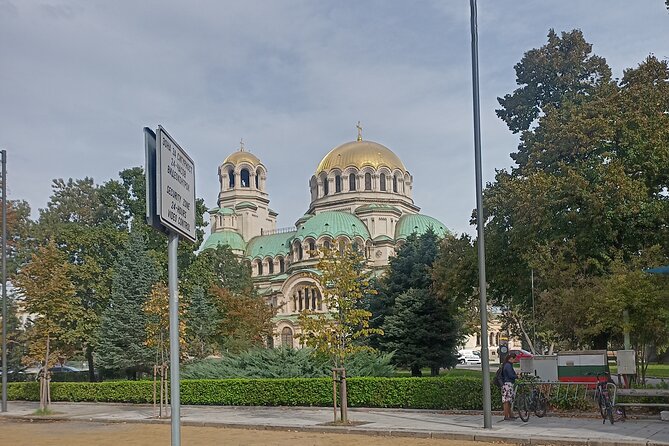
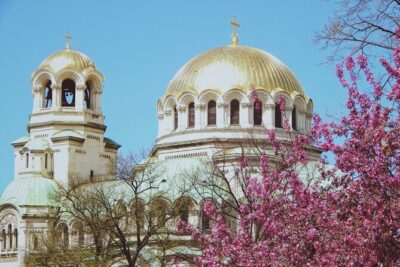
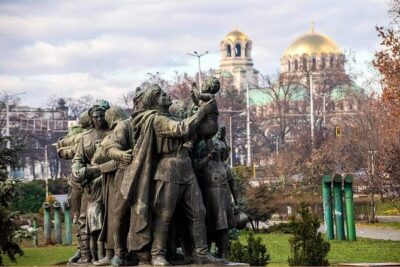
From Saint Sofia, the route continues to St. Alexander Nevski Cathedral, Sofia’s most recognizable church. Its Neo-Byzantine design and enormous scale make it an easy landmark to spot, even among the capital’s broad avenues and formal buildings.
The stop lasts about ten minutes and admission is free. That gives you time to take in the exterior and enter if conditions allow, but not to study every chapel, icon, or interior detail. If you are especially interested in Bulgarian Orthodox art, treat this as an introduction and return on your own.
The route then moves through Sofia’s cultural and institutional center. Kvadrat 500, the largest building of Bulgaria’s National Gallery, opened in 2015. Its collection includes Bulgarian art from the mid-19th century onward, European works from the 15th to 19th centuries, and art from Asia, Africa, and America. Some 1,700 works are displayed in 28 rooms across four levels.
The tour does not provide enough time for a full museum visit, so think of Kvadrat 500 as a useful landmark and a possible later stop. Art lovers should note its location and return with at least several hours free.
Inside the National Library and Sofia University
One of the tour’s best features is the chance to go inside the St. St. Cyril and Methodius National Library. The collection contains nearly 8.5 million documents, and the institution receives about 70,000 publications each year. You spend roughly ten minutes here without an admission fee.
That interior visit gives the route more substance than a standard photo stop. You see a working center of Bulgarian scholarship, not only another handsome building on a sightseeing street. The library is named for Cyril and Methodius, the brothers associated with the Slavic literary tradition, an important part of Bulgaria’s cultural identity.
The next stop is Sofia University St. Kliment Ohridski, Bulgaria’s first higher education institution. Its story reaches back to centuries of teaching and cultural work, with the idea of higher education taking shape during the Bulgarian Renaissance. The university’s role grew after Liberation in 1878.
You visit inside for about ten minutes. This was a highlight for one returning visitor who had already seen Sofia several times but still learned new facts and appreciated entering places often viewed only from outside. That is useful advice: the tour has value even if you already know the central sights, because access and explanation can change familiar streets.
Opera, theatre, and the socialist Largo
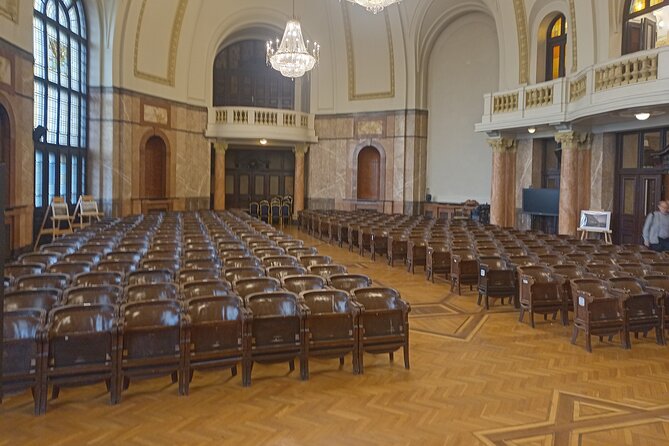
The walk also passes several buildings tied to Bulgaria’s performing arts and government life. One neo-Renaissance building was designed by Constantin Yovanovic, an architect who studied in Vienna and Switzerland and also designed the Serbian Assembly.
Sofia’s opera story began in 1890, when Dragomir Kazakov, Ivan Slavkov, and Angel Bukoreshtliev organized the first Bulgarian opera troupe. Its early program included complete operas and excerpts, with Bulgarian, Czech, and Italian participants and musical support from several ensembles.
You then reach the National Theatre, completed in 1906 and opened in January 1907. Architects Ferdinand Fellner and Hermann Helmer designed the Art Nouveau building, while Rudolf Fuchs of Vienna painted the auditorium’s ceiling and walls. The hall seats 848 people.
These stops are mainly architectural and historical rather than full performances or extended tours. Still, they help explain Sofia as a capital shaped by education, music, theatre, and state-building. Keep your eyes up. The details are often above street level.
The route also crosses the Largo, a group of three Socialist Classicism buildings created in the 1950s as Sofia’s representative center. This is one of the city’s sharpest visual shifts. Within a short walk, you move from Roman ruins and medieval religious buildings to monumental 20th-century government architecture.
A completely different kind of day:
- Rila Monastery and Boyana Church Full-Day Tour
★ 4.5 · 918 reviews - Sofia Escape Room – Teorema Rooms
★ 5.0 · 895 reviews - From Sofia: Rila Monastery & Boyana Church Day Tour
★ 4.5 · 866 reviews - Admission Ticket to the Museum of Illusions in Sofia
★ 5.0 · 659 reviews
The Rotunda of St. George and Ancient Serdica
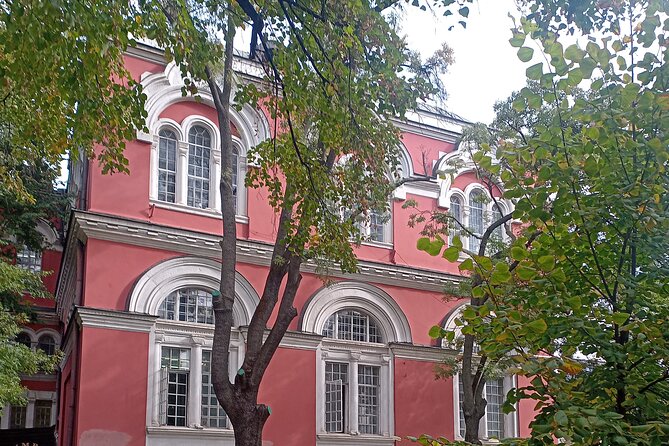
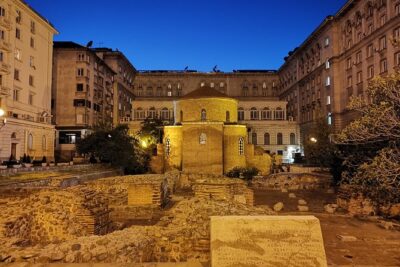
The Rotunda Church of St. George is one of Sofia’s most remarkable stops. The red-brick building dates to the early fourth century and began as part of Roman baths. It later became a Christian church inside Serdika, the Roman and Byzantine-era city.
The stop lasts about five minutes and costs nothing. That sounds brief, but the rotunda is compact, and its position among later buildings makes the setting especially memorable. You are looking at what is considered the oldest building in modern Sofia, surrounded by the capital’s newer layers.
Next comes the Ancient Serdica Archaeological Complex, where about fifteen minutes are allotted. Under the Largo and Nezavisimost Square, you can see the remains of the Roman city’s main east-west street, the decumanus maximus. A large residential building once occupied a full urban block, with small shops selling food and other goods.
This is where the route’s earlier stops come together. Sofia is not simply a city with a few Roman stones placed in a park. Its ancient streets lie beneath the political center, and the modern city continues above them. The archaeological zone includes spaces for cultural events and a nearby lapidarium.
The limitation is time. Fifteen minutes lets Peter explain the layout and point out key remains, but not examine every stone or inscription. If Roman archaeology is your main interest, you will want a separate visit.
Mineral baths, synagogue, and Ottoman Sofia
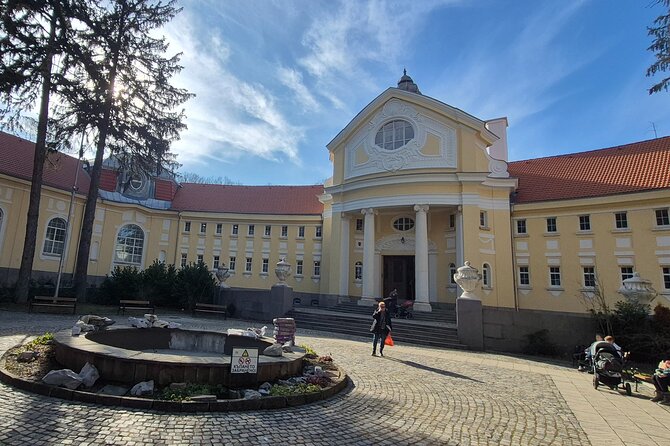
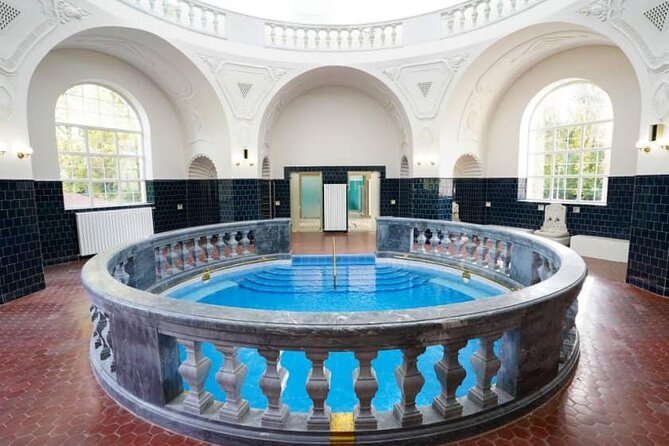
The Central Mineral Baths add another layer to the route. The present building was designed in 1904 and 1905 in the Vienna Secession style, with Bulgarian, Byzantine, and Eastern Orthodox decorative elements. Architects Petko Momchilov and Friedrich Grünanger created a building that reflects Sofia’s long connection with hot mineral springs.
The stop takes about ten minutes. You will not have time for a bath experience here, but the building helps explain why the area has been important for centuries. Its location near Banski Square also places you close to several other central landmarks.
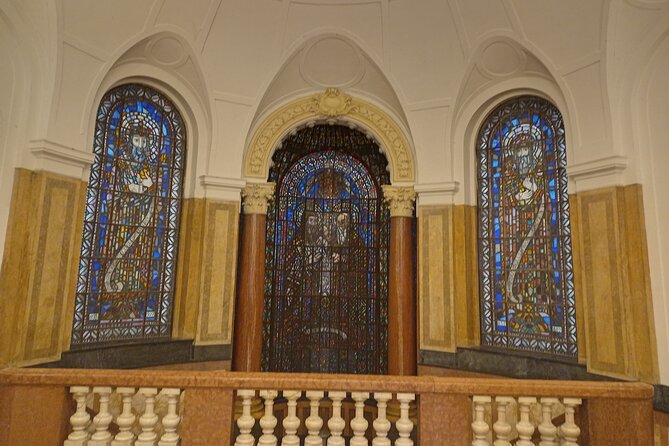
The route includes Sofia’s Central Synagogue, built in the early 20th century. Rabbi Dr. Ehrenpreis and community president Ezra Sol helped organize the project, and architect Friedrich Grünanger completed it in four years. The building replaced an earlier synagogue called Ahava ve Chesed, meaning Love and Goodness.
A particularly unusual detail is that tombstones from an old Jewish cemetery were used in the synagogue’s base. After entering, you can see the names of the ten largest contributors on the left wall. The construction cost 437,000 golden leva, a substantial sum at the time.
The tour then reaches the Western Gate of Serdika. A preserved section of the fortress wall includes a pentagonal tower near the gate and a triangular tower close by. The location sits between St. Joseph Catholic Cathedral, Todor Alexandrov Boulevard, and the city monument.
This part of Sofia is valuable because it places several religious traditions and historical periods close together. You see Orthodox, Jewish, Catholic, Ottoman, Roman, and modern Bulgarian influences within one compact central route.
The Women’s Market and Banya Bashi Mosque
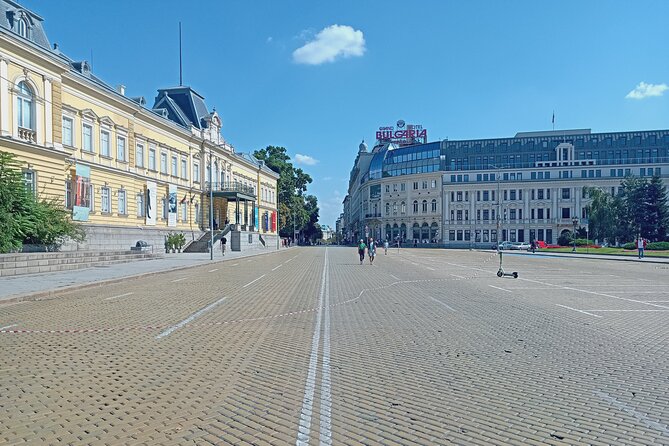
The Zhenski Pazar, or Women’s Market, is Sofia’s oldest market, with more than 140 years of trading behind it. The tour allows about ten minutes here, which is enough to get a taste of the setting but not enough for a leisurely food-shopping expedition.
I like this stop because it changes the mood. After formal churches, theatres, libraries, and government buildings, the market shows Sofia as a place where people buy and sell ordinary goods. You may want to return later if you have time, especially if you enjoy markets more than monuments.
The tour ends near Banya Bashi Mosque and Sofia’s Central Market Hall. Banya Bashi means many baths, a name tied to the hot mineral springs nearby. The mosque was built in 1576 during Ottoman rule by the celebrated architect Mimar Sinan, also associated with major mosques in Edirne and Istanbul.
The official ending point is the Central Sofia Market Hall on Maria Luiza Boulevard, with the tour finishing on level minus one. It is close to a bus station, so you can continue your day without crossing the city to find transport. The precise end point also makes this tour practical for a first morning in Sofia, when you want help getting oriented.
What the $45.66 price gets you
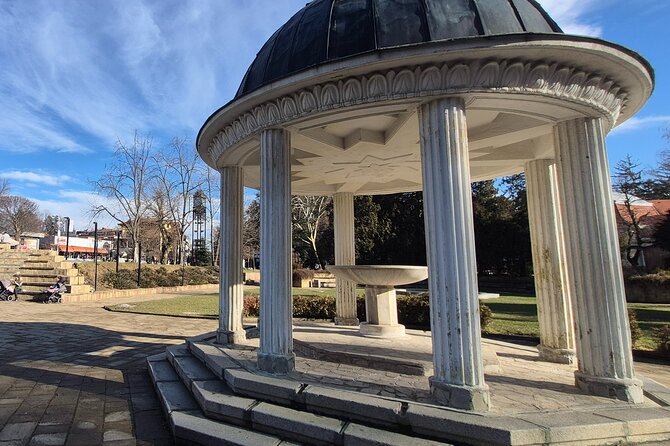
At $45.66 per person, the tour is not the cheapest way to walk around central Sofia. Many of the stops have free admission, and you could visit several landmarks independently.
The value comes from the route and the explanation. Peter links Roman Serdika, Orthodox Bulgaria, Ottoman Sofia, Jewish Sofia, socialist architecture, public education, and the modern market district. You also receive an English-speaking guide, a city transport card, and a short tram or metro ride.
A group limit of 10 matters here. Sofia’s center has many layers, and a large group would make questions and short indoor visits harder. With a small group, Peter can adjust his explanations and add bonus locations when time permits.
The tour is commonly reserved well ahead, with bookings often made about 25 days before the date. That is not a reason to panic, but it is sensible to reserve early if your Sofia schedule is fixed.
Timing, walking, and who should book
The advertised duration is approximately two to three hours. The longer end seems more realistic when you include the transport ride, indoor visits, questions, and the many short stops. Since travel time from place to place is part of the tour, you should not expect two or three uninterrupted hours at monuments.
Wear comfortable shoes. Bring sunscreen, especially in warmer months, since the route includes outdoor streets and open archaeological areas. The tour is near public transportation, includes a short public transport ride, and most people can participate.
This is a strong choice for a first visit, a short stay, or anyone who wants a connected story instead of isolated snapshots. It also suits someone who has visited Sofia before but has not entered the library or university.
It is less suitable if you want long museum visits, extended cathedral time, or a relaxed café pace. The route covers a lot, and the reward is breadth. You should plan a return visit to the National Gallery, cathedral, market, or any other stop that catches your attention.
Peter’s guiding style is a clear strength. He is described as patient and energetic, with a passion for Bulgarian history and a willingness to answer questions on many subjects. He also has a friendly practical side, helping with souvenirs and offering water. Those small acts matter on a fast city walk.
Should you book this Sofia tour?
Book it if you want a compact introduction to Sofia that goes beyond the postcard sights. The combination of Saint Sofia, Alexander Nevski Cathedral, Serdica, the mineral baths, synagogue, mosque, Women’s Market, National Library, and Sofia University gives you a broad sense of the capital in one morning or afternoon.
Skip it if you already have a detailed self-guided plan and prefer to spend an hour or more inside each museum and church. At $45.66, the price makes the most sense when you value Peter’s explanations, the small group, the inside visits, and the included transport.
For most first-time visitors, I would book this early in the stay. Use it to understand the city’s layout, then return on your own to the places that deserve more time. Free cancellation is available up to 24 hours before the start time, which gives you some flexibility if your plans change.
FAQ
How long does the Sofia walking tour last?
The tour lasts approximately two to three hours, including travel time between stops.
What language is the tour offered in?
The tour is offered in English.
How much does the tour cost?
The listed price is $45.66 per person.
What is included in the tour?
An English-speaking guide, a city transport card, and a short tram or metro ride are included.
Where does the tour begin?
The tour begins at Saint Sofia Church, Old City Center, ul. Paris 2, 1000 Sofia, Bulgaria.
Where does the tour end?
It ends at Sofia’s Central Market Hall, on level minus one, at bul. Knyaginya Maria Luiza 25. The ending is close to a bus station.
How large is the group?
The tour has a maximum of 10 people.
Are admission tickets included?
The listed stops have no admission charge. The tour includes brief visits to places such as the National Library and Sofia University, while longer museum visits are not part of the stated program.
Can I cancel for a full refund?
Yes. You can cancel at least 24 hours before the experience start time for a full refund. Cancellations or changes made less than 24 hours before the start time are not accepted for a refund.
Just added in Sofia
- Private Winter Day Trip to the Rila Mountain★ 4.5 · 3 reviews
- Wind Mills Hydropark Tours & Activities★ 5.0 · 1 review
- Weekend in Bulgaria★ 5.0 · 1 review
- Vratsa Karst and Caves★ 5.0 · 1 review
- Via Ferrata Adventure on Kuklata peak 2257 m in Rila Mountain★ 5.0 · 8 reviews
- Vitosha Trail Hunter Bike Tour from Sofia★ 5.0 · 9 reviews
- Vitosha Mountain- Heritage and Hiking- Private Day Trip★ 5.0 · 2 reviews
- Private Day Trip to the Vitosha Mountain and Pancharevo Lake★ 4.5 · 13 reviews
Walking Tours in Sofia, compared.
Sofia Highlights 2 Hour Sightseeing Walking Tour
Read our review →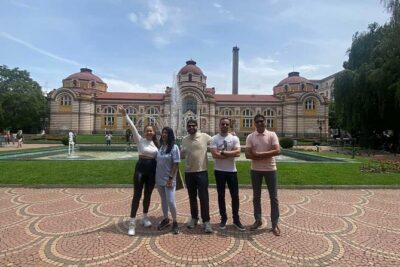
Browse the lists this tour appears in