
REVIEW · SELF-GUIDED TOURS
Plovdiv Old Town Self-Guided Audio Tour
Plovdiv rewards a slow walk. This self-guided route links Roman ruins, Ottoman landmarks, old Bulgarian houses, and hilltop archaeology without tying you to a group schedule. I like the freedom to start when you choose and the way the audio guide gives each stop a clear historical frame. I also like that the route reaches major sights such as the Roman Theatre, Nebet Tepe, and the Ancient Stadium of Philippopolis in one outing.
The main drawback is practical rather than historical: you must manage the map, phone, and audio yourself. One person found the PDF map hard to read in bright sun, especially when zoomed in, so you should download everything and get your bearings before setting off. The route is also best for people with moderate fitness, since Plovdiv’s Old Town includes hills and uneven walking.
In This Review
- Key points to know before you book
- Starting beside the Ancient Stadium of Philippopolis
- Ancient Philippopolis in the middle of town
- The Ancient Theatre deserves extra time
- Houses, museums, and the Old Town’s changing pace
- Three paid sites worth planning around
- How the audio format works in real life
- Is $15.49 a fair price?
- Who will enjoy this walk most?
- My verdict on the Plovdiv audio tour
- FAQ
- Where does the Plovdiv Old Town audio tour start?
- Where does the tour finish?
- How long does the tour take?
- What language is the audio guide offered in?
- Is this a group tour?
- Are museum admissions included?
- Which stops are marked as free?
- Is the tour suitable for all fitness levels?
- Can I cancel for a refund?
Key points to know before you book
- Roman sights anchor the route: The Ancient Stadium, Ancient Theatre, Small Basilica, and TrakArt museum give the walk real historical weight.
- You control the pace: The tour takes about two to three hours, but the self-guided format lets you pause for museums, photographs, or a meal.
- The route crosses several eras: You move from medieval Islamic architecture and Ottoman-era history to ancient Philippopolis and 19th-century Bulgarian houses.
- Three attractions require paid admission: Entry is not included for the Ethnographic Museum, Small Basilica, or Cultural Center-Museum TrakArt.
- The hilltop stops matter: Nebet Tepe and the surrounding Old Town give you some of the best historical context and city views on the walk.
- A restaurant discount adds modest value: Your ticket includes a 15 percent discount at a city restaurant.
Starting beside the Ancient Stadium of Philippopolis
The meeting point is the Ancient Stadium of Philippopolis on ul. Hristo G. Danov in central Plovdiv. This is a sensible place to begin because the stadium immediately shows you that Plovdiv is not simply a pretty old quarter. The modern city sits on top of ancient Philippopolis, and Roman remains appear in the middle of everyday streets.
The stadium dates from the 2nd century AD, during the Roman imperial period. The planned stop is about 10 minutes, with free admission. I would give yourself a few extra minutes here before starting the audio, since this first stop helps you understand the scale of the Roman city and gives you a clear reference point for the route.
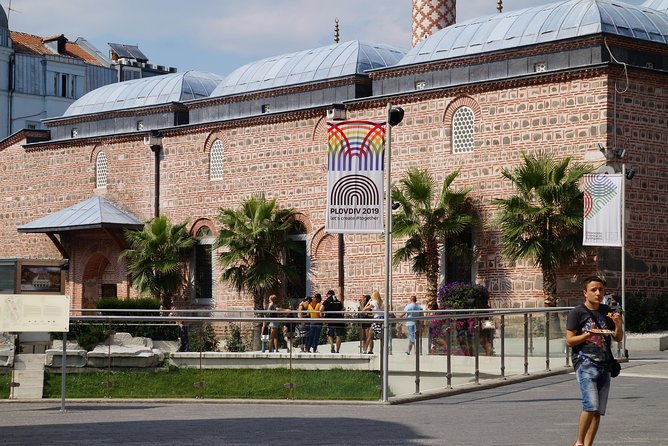
From there, you walk toward Djumaya Mosque, also called Jumaya Mosque. This medieval Muslim temple is associated with Sultan Murad I or Sultan Murad II, depending on the historical source. The short five-minute stop works well as an introduction to the city’s Ottoman period.
You do not pay to enter this stop, but the brief timing suggests that the audio focuses on history and orientation rather than a long interior visit. Listen carefully here. The mosque is not just an isolated monument. It sits among Roman remains and later city buildings, which is one of the things that makes Plovdiv rewarding to explore on foot.
More self-guided routes in Plovdiv:
- Roman Plovdiv, Self-Guided Tour and Urban Quest Game
★ 5.0 · 6 reviews - Plovdiv Roman Sights Self-Guided
★ 4.5 · 3 reviews - Rila Monastery and 7 Rila Lakes Self-Guided Shared Trip from Sofia
★ 5.0 · 280 reviews
Ancient Philippopolis in the middle of town
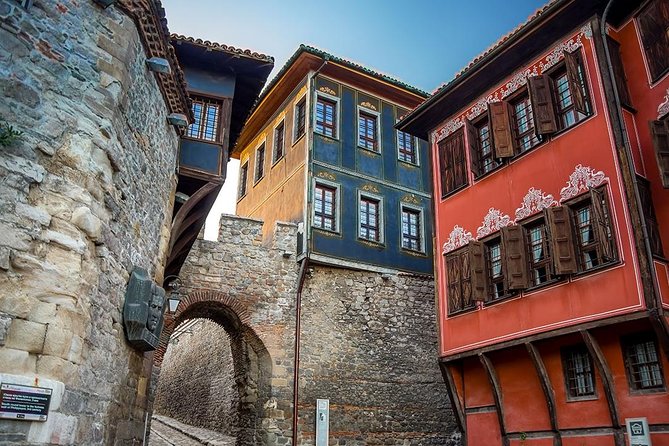
The route then moves through the Church of the Holy Mother of God, Casa Lamartine, and the Balabanov House. These stops change the mood from ancient ruins to Bulgarian religious and domestic architecture.
A small church existed on the site of the Church of the Holy Mother of God as early as the 9th century. It was renovated in 1186 by Constantine Pantehi, bishop of Plovdiv, and became part of a monastery. Both church and monastery were destroyed after the Ottoman conquest of the city in 1371.
The suggested stop lasts 15 minutes and admission is free. That gives you time to take in the site without turning the visit into a long church tour. The audio context is useful because the building’s importance is tied to several layers of change: early Christian worship, medieval restoration, monastic life, destruction, and the later history of Plovdiv.
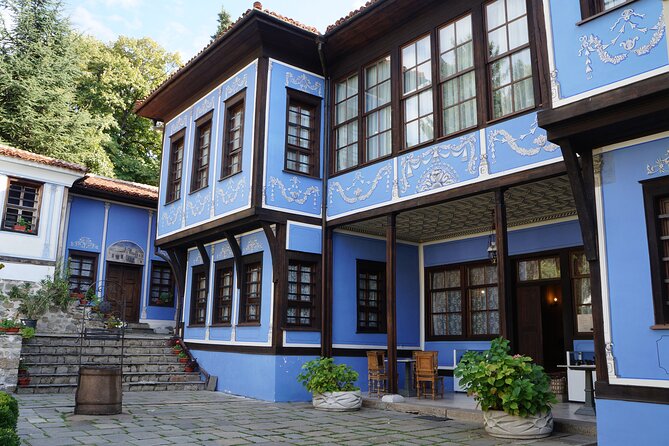
Casa Lamartine is a different kind of stop. Built by an unknown master-builder in 1829 and 1830, it is one of the largest and most handsome symmetrical houses in the Old Town. The planned visit lasts six minutes. I would treat it as a quick architecture lesson, a chance to notice the proportions and style of the building rather than an extended museum visit.
The Balabanov House, also called the House of Hadji Panayot Lampsha, dates from the beginning of the 19th century. The stop lasts about 10 minutes, with no admission fee included because entry is free according to the tour details. Together, Casa Lamartine and Balabanov House help explain why Plovdiv’s Old Town is more than a collection of ancient ruins. Its character also comes from the grand homes of later centuries.
The Ancient Theatre deserves extra time
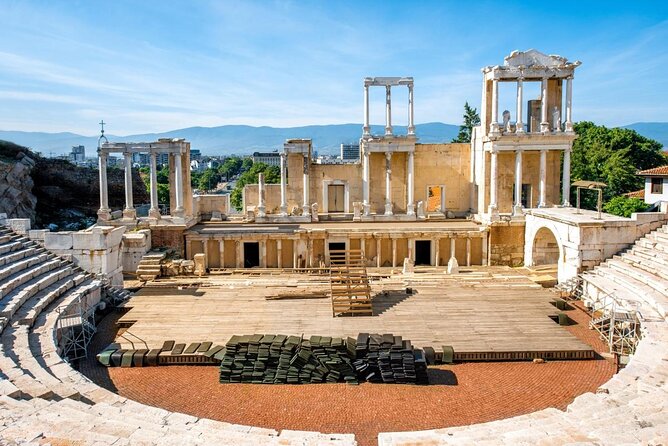
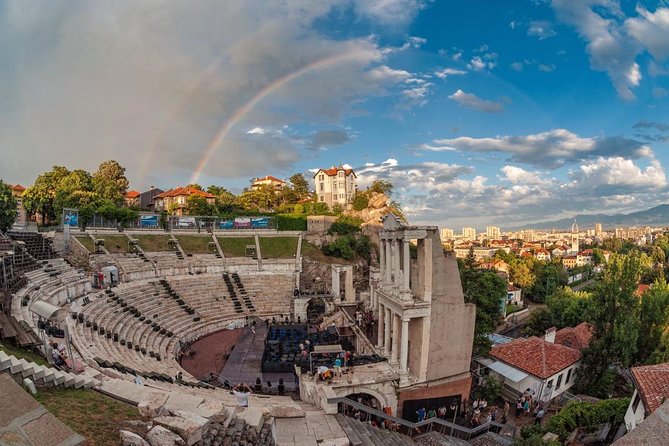
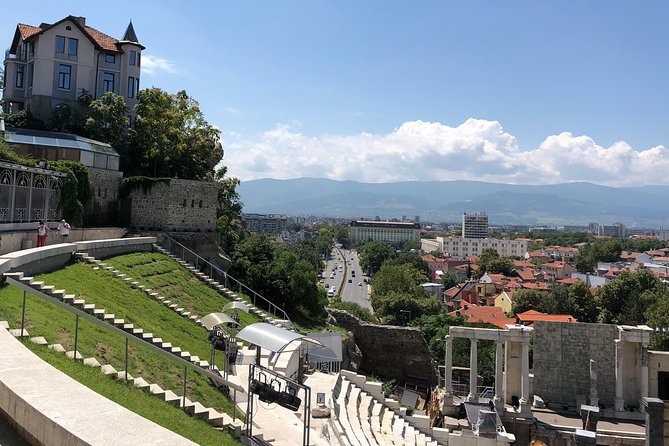
The Ancient Theatre of Philippopolis is the emotional center of the walk for many people, and it is easy to see why. It is one of the best-preserved ancient Roman theatres in the world, located in the center of modern Plovdiv on the site of the ancient city.
The suggested stop is 10 minutes, but I would not feel bound by that number. The self-guided format gives you room to pause, study the stone seating, and take in the views from the theatre. A short audio explanation can tell you what you are looking at, but the physical setting does much of the work.
This is also a good place to remember that the tour price does not cover every possible admission. The itinerary marks the theatre as free, but the Ethnographic Museum, Small Basilica, and TrakArt have admission not included. If you plan to enter those three sites, keep extra money and time available.
The theatre is especially valuable for first-time visitors who want one major Plovdiv sight without spending a full day on formal museum visits. It is also the stop most likely to make you glad you chose a walking route. You see an ancient monument in the middle of a living city, not behind a distant archaeological fence.
Houses, museums, and the Old Town’s changing pace
The Plovdiv Regional Ethnographic Museum is the second-largest specialized museum of its type in Bulgaria. The planned visit is only five minutes, and admission is not included. That timing tells you something important: the route points out the museum, but it does not build in a full museum visit.
If you want to see the collections properly, use the audio tour as a framework and return for a longer visit. If you are trying to keep the outing within two or three hours, you can admire the building from outside and save the interior for another day.
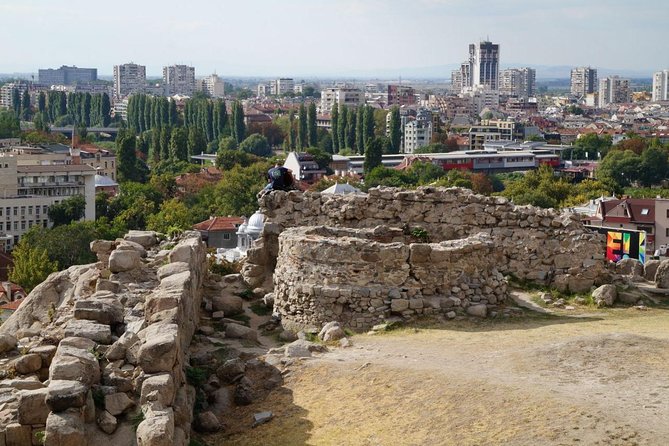
The walk continues to Nebet Tepe, one of the hills where Plovdiv’s ancient town began. The earliest settlements here date to around 4000 BC. This is one of the most important stops for understanding the city, since it reaches back far earlier than the Roman period.
The suggested time is 15 minutes, with free admission. Nebet Tepe is also where the physical demands of the route matter most. The tour asks for moderate fitness, and you should expect the hilltop portion to feel more tiring than the shorter city-center stops. In return, you get archaeology and a broader view across Plovdiv.
The route then reaches Hisar Kapia, a medieval gate whose name comes from the Turkish phrase meaning Castle Gate. It is one of the Old Town’s best-known sights. The stop lasts about five minutes and costs nothing to enter.
Hisar Kapia works well as a compact stop because you can see its importance quickly. The gate connects the Old Town’s hilltop setting with its medieval defensive past. It also gives the route a strong sense of movement: you are not simply walking from one museum to another, but tracing the edges and entrances of an older city.
A completely different kind of day:
- Private city walking tour of Plovdiv
★ 5.0 · 65 reviews - Food Walk: Bulgarian Food and Culture Tour in Plovdiv
★ 5.0 · 35 reviews - Wonderful Bridges-Bachkovo Monastery-Assen’s Fortress – day tour from Plovdiv
★ 5.0 · 32 reviews - Plovdiv guided walking tour
★ 5.0 · 31 reviews
Three paid sites worth planning around
The final section includes the Small Basilica of Philippopolis, Cultural Center-Museum TrakArt, and Saints Constantine and Helena. These stops are close in theme but different in feel, and the entrance fees make advance planning useful.
The Small Basilica is an archaeological site from the 5th and 6th centuries. The scheduled stop is 15 minutes, but admission is not included. It is an important addition to the Roman Theatre because it shows the later Christian phase of the city. One person specifically found the Small Basilica a must-see, and I agree that it deserves serious consideration if you are willing to pay for one extra entry.
The Cultural Center-Museum TrakArt also requires a separate admission fee. Its displays include 160 square metres of ancient Roman mosaic preserved in situ, dating from the 3rd and 4th centuries. The museum also presents glass from ancient art, with objects showing the development of glassmaking from the 5th century BC through the 4th century AD.
TrakArt adds variety to the day. You are not looking only at large ruins or exterior walls. You can also see smaller objects, decorative work, and a Roman mosaic in its original setting. The museum includes ceramic pieces from the Eneolithic and Neolithic periods, along with Roman miniature portraits from the 1st century BC to the 1st century AD.
The final stop is the Church of Saints Constantine and Helena. It is considered one of Plovdiv’s oldest churches and was built in 337 at the site of an ancient pagan temple in the acropolis on one of the fortified hills. The planned stop lasts 10 minutes, with free admission.
This ending brings several strands together: pagan foundations, early Christianity, fortified hills, and the long religious history of Plovdiv. The tour finishes back at the starting point, so you do not need to arrange transport from a distant endpoint.
How the audio format works in real life
The strongest feature here is control. You can walk at your own speed, stop for a meal, spend longer at the theatre, or enter one of the museums without holding up a group. That matters in Plovdiv, where the best moments often come from looking closely rather than rushing between marked sights.
The audio guide is offered in English and arrives as a mobile ticket. Confirmation is provided at booking. The tour information lists operating hours from 9 a.m. to 6 p.m., Monday through Sunday, for the stated operating period.
Access to the audio guide has been increased to 72 hours, according to the provider’s response to an earlier timing concern. That is a useful improvement. You can split the route across more than one day if your access period and plans allow it, though the listed walking experience itself is designed to take about two to three hours.
The map deserves attention. You need to switch between the map and audio, and the PDF map may be difficult to read in bright light or when enlarged. I would download the guide before leaving, charge your phone, and check the route while you still have a clear view of the screen. A printed map would be easier for some people, especially in strong sun, but none is specified as part of the experience.
This is a private activity for your own group, not a shared walking group. That means you avoid a fixed group pace, but you also do not have a person beside you to solve a wrong turn or answer a question. If you enjoy independent sightseeing, that is a fair trade.
Is $15.49 a fair price?
At $15.49 per person, the value depends on how you use the route. You are paying for an English audio guide, a planned path through major landmarks, and the ability to explore independently. You are not paying for museum admissions, a live guide, or transport.
For a two to three-hour introduction to Plovdiv, the price is reasonable if you want structure but dislike group tours. The route covers 12 stops and several major periods of the city’s past. It can also save you the work of deciding how to connect the Ancient Stadium, Roman Theatre, Nebet Tepe, Hisar Kapia, and the later houses.
The value improves if you use the 15 percent restaurant discount. That discount is not enough to decide on the tour by itself, and the restaurant is not identified in the supplied details, but it can reduce the overall cost of a day in the Old Town.
You should budget separately for the Ethnographic Museum, Small Basilica, and TrakArt. Those admissions are not included. The other listed stops are marked free, though you should still follow the on-site rules and opening arrangements when entering religious buildings.
Who will enjoy this walk most?
I would choose this experience if you want a self-paced overview of Plovdiv with enough history to make the monuments meaningful. It suits independent visitors, couples, families with older children, and anyone who prefers to pause without asking a guide to wait.
It is also a good fit if you have limited time in the city. The route gathers Roman, medieval, Ottoman, early Christian, and 19th-century sights into one compact walk. You can complete it in one outing or use the 72-hour audio access to give yourself more breathing room.
You may want something else if you need a live guide, a highly polished paper map, or help navigating every turn. The route is designed for moderate fitness, and the hilltop stops may be uncomfortable if walking uphill or over uneven ground is difficult.
The average rating is 4.5 from six ratings, and the strongest praise centers on three things: clear explanations, an easy route, and the freedom to walk at a personal pace. One person spent the whole day with the guide and visited three museums, showing how flexible the format can be. Another praised the theatre and its views as a reason to make the visit.
My verdict on the Plovdiv audio tour
Book this tour if you want a useful structure for exploring Plovdiv without surrendering your independence. The Roman Theatre, Ancient Stadium, Nebet Tepe, and Small Basilica give you strong historical stops, while Casa Lamartine, Balabanov House, and the churches show how the city changed over many centuries.
I would book it with three small preparations: download the audio and map in advance, plan which paid museums you want to enter, and allow extra time for Nebet Tepe and the Ancient Theatre. If you want a live person to guide you, skip it. If you like setting your own pace and learning as you walk, $15.49 is a sensible way to get oriented in Plovdiv.
Free cancellation is available if you cancel at least 24 hours before the experience begins. Changes or cancellations made inside that period are not accepted for a refund.
FAQ
Where does the Plovdiv Old Town audio tour start?
It starts at the Ancient Stadium of Philippopolis on ul. Hristo G. Danov in central Plovdiv.
Where does the tour finish?
The activity ends back at the meeting point, at the Ancient Stadium of Philippopolis.
How long does the tour take?
The estimated duration is about two to three hours.
What language is the audio guide offered in?
The audio guide is offered in English.
Is this a group tour?
No. It is a private activity for your own group, using a self-guided audio format.
Are museum admissions included?
No. Admission is not included for the Ethnographic Museum, Small Basilica of Philippopolis, or Cultural Center-Museum TrakArt.
Which stops are marked as free?
Djumaya Mosque, the Ancient Stadium of Philippopolis, Church of the Holy Mother of God, Casa Lamartine, Balabanov House, Ancient Theatre of Philippopolis, Nebet Tepe, Hisar Kapia, and Saints Constantine and Helena are marked as free stops.
Is the tour suitable for all fitness levels?
The booking information recommends a moderate physical fitness level. The route includes hilltop areas such as Nebet Tepe, so you should consider your comfort with walking and uphill sections.
Can I cancel for a refund?
You can cancel up to 24 hours before the experience start time for a full refund. Cancellations or changes made less than 24 hours before the start time are not accepted.
Just added in Plovdiv
- Unlock Six Starosel Treasures: A Delicious Tasting Experience★ 5.0 · 1 review
- Walking tour of Plovdiv’s top attractions★ 5.0 · 1 review
- Veliko Tarnovo – Arbanassi – Shipka Memorial Church – private tour from Plovdiv★ 4.5 · 6 reviews
- Transfer from Plovdiv to Stara Zagora★ 5.0 · 1 review
- Transfer from Plovdiv to Pamporovo★ 5.0 · 1 review
- Transfer Plovdiv to Sofia airport/city with a car 3+1★ 5.0 · 3 reviews
- Private Buggy Experience All Seasons in Pamporovo★ 5.0 · 3 reviews
- Starosel Thracian Temple and Hisarya spa resort – private day tour from Plovdiv★ 5.0 · 1 review
Self-Guided Tours, compared.

Rila Monastery and 7 Rila Lakes Self-Guided Shared Trip from Sofia
Read our review →
Rila Monastery and Boyana Church Self-Guided Day Trip from Sofia
Read our review →
Self-guided tour in Varna Archaeological Museum + ticket
Read our review →
Discover Veliko Tarnovo at Your Pace: Private or Self-guided tour
Read our review →
Browse the lists this tour appears in